- Blueprint Soccer XI
- Posts
- The Luis Enrique Blueprint: How PSG Conquered Europe with Unity Over Stars
The Luis Enrique Blueprint: How PSG Conquered Europe with Unity Over Stars
Paris Saint-Germain’s Champions League Glory: How Luis Enrique’s Vision Transformed PSG into Europe’s Elite
Blueprint Soccer XI
June 08, 2025
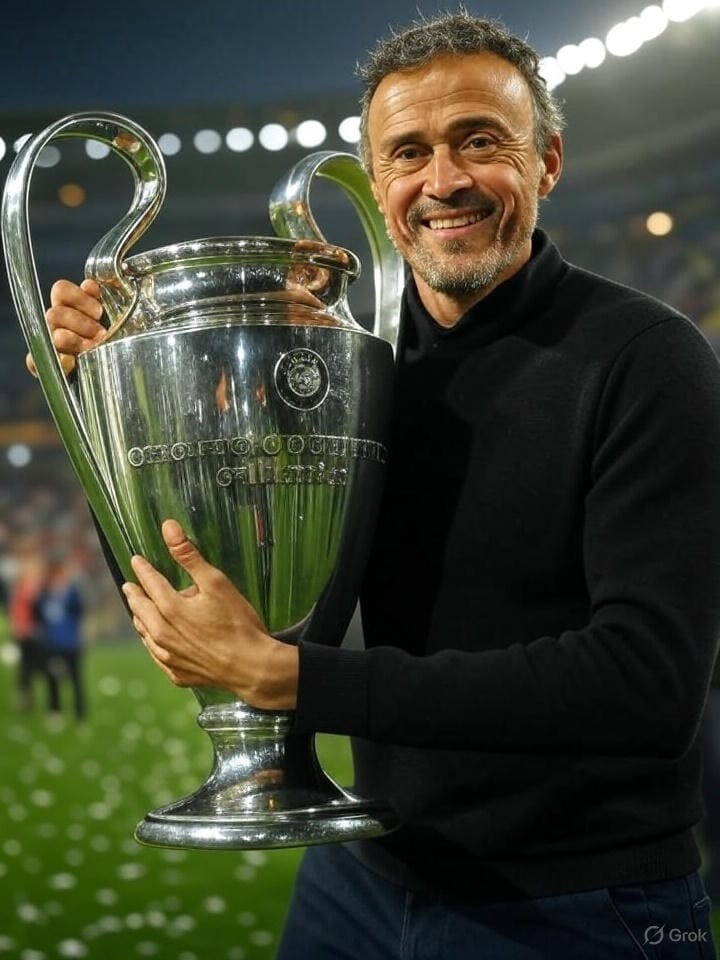
In June 2025, Paris Saint-Germain finally scaled the European summit. After years of heartbreak, near-misses, and star-studded frustration, the club from the French capital delivered a footballing masterclass to lift their first UEFA Champions League title. At the heart of this historic campaign stood one man — Luis Enrique, the tactical genius and principled leader who reshaped the DNA of PSG.
While Kylian Mbappé’s high-profile move to Real Madrid had dominated headlines in the early months of 2025, Luis Enrique was quietly building something far more enduring in Paris: a team in the truest sense of the word. He made bold decisions, laid down clear values, and in doing so, turned Paris Saint-Germain from a club of individuals into a symphony of collective brilliance.
The Luis Enrique Blueprint: No Star Above the System
Luis Enrique arrived in Paris with a clear message: no player is bigger than the team and no one is special. It was a message that would test PSG’s identity, especially with a global superstar like Mbappé in the dressing room.
In private conversations, Enrique reportedly sat down with Mbappé and told him bluntly:
“I read that you liked Michael Jordan. Michael Jordan ... defended like a son of a @#$%* You're a phenomenon, without a doubt, but that doesn't matter to me. A true leader is when you can't help more with the goals ... you help us in everything defensively. ... The day that you don't attack, you have to be the best player in history defending. That is a leader. That is Michael Jordan.”
That message resonated — at least temporarily. In the 2023/24 UEFA Champions League campaign, Mbappé contributed significantly during the group stages and knockout rounds but when bowing out in the semifinals to Borussia Dortmund he began to express doubts about Enrique’s egalitarian system. With his contract expiring, and Real Madrid circling, the decision was made amicably: Mbappé would move to Madrid in the summer, leaving the team to chase glory without him in the coming year.
And remarkably, PSG flourished without their talisman.
Ousmane Dembélé: From Injury-Plagued Enigma to Ballon d’Or Contender
With Mbappé’s departure, many feared a creative void. Instead, Ousmane Dembélé emerged as the star of the season. Once maligned for inconsistency and repeated injuries at Barcelona, Dembélé found a new life under Luis Enrique.
Enrique revitalized Dembélé's career by handing him freedom within a structured system. The French winger thrived in a fluid front three, often interchanging with the likes of Bradley Barcola, Desire Doue, Gonçalo Ramos and the January transfer window addition of Khvicha Kvaraskhelia. Enrique encouraged Dembélé to find space, isolate defenders, and exploit 1v1 situations — a vintage approach that unlocked defenses across Europe.
Champions League Stats (2024/25):
Goals: 8
Assists: 6
Passes into Penalty Area: 44
Successful Dribbles: 24
Dembélé’s dynamism became PSG’s sharpest weapon. In the semifinal, he notched a stunning goal and assist, against Arsenal. It was performances like these that made pundits and fans alike whisper the once-unthinkable: Is Dembélé the next Ballon d'Or winner?
The Final: PSG Dismantle Inter Milan with Ruthless Precision
In the 2025 UEFA Champions League final at the Allianz Arena, Paris Saint-Germain delivered the most dominant performance in the competition’s history, dismantling Inter Milan 5-0 to capture their maiden European crown.
Luis Enrique’s side approached the final with clarity, confidence, and tactical precision. Operating primarily in a 4-3-3 base shape that fluidly transitioned into a 3-2-5 when in possession, PSG immediately imposed their structure and tempo on the game. Inter Milan, lining up in their familiar 3-5-2 under Simone Inzaghi, struggled to cope with PSG's aggressive press and constant positional rotations.
From the first whistle, PSG pressed high, pinned Inter into their own third, and created overloads down both flanks. Ousmane Dembélé and Désiré Doué constantly rotated, dragging Inter’s wing-backs out of shape and exposing space in behind. That space was exploited in the 12th minute when Doué slipped in Achraf Hakimi, who rifled the opener past Yann Sommer. Just eight minutes later, a whipped cross from Dembélé forced a deflection off Federico Dimarco, and Doué pounced for PSG’s second.
PSG’s approach was built on structure and synchronicity. Midfielders Joao Neves and Vitinha controlled the tempo, while Fabian Ruiz operated in pockets to link the phases. Enrique’s emphasis on “collective superiority over individual brilliance” was never more evident than in this match.
The tactical domination continued in the second half. In the 63rd minute, Doué finished off another flowing move, becoming only the second teenager since Eusébio (1962) to score a brace in a European Cup final. The final 20 minutes saw PSG maintain their relentless tempo, with Khvicha Kvaratskhelia (on as a substitute) adding a fourth with a curling effort before Senny Mayulu, another teenager, capped the historic performance with the fifth in stoppage time.
It was a tactical masterclass by Luis Enrique. He neutralized Inter's compact mid-block by stretching the pitch and constantly rotating personnel, disorienting their defensive shape. Inter, known for their structured transitions and wing-back productivity, were stifled and suffocated.
This performance did more than secure PSG’s first UEFA Champions League trophy — it redefined what modern team football could look like on the grandest stage. No single player carried the side. Every touch, every press, and every off-ball run was part of a greater symphony of control and conviction.
Luis Enrique's philosophy was on full display: “No player is bigger than the collective, but each player makes the collective brilliant.”
Key Final Stats:
Possession: PSG 59%
PSG Shots: 23 (8 on target)
Inter Milan shots on target: 2
Pass Accuracy: 88%
Final Score: PSG 5-0 Inter Milan (most lopsided win in UCL final history)
A New Chapter for PSG and European Football
Luis Enrique’s triumph is more than just a trophy — it is a blueprint for modern footballing success. In an era obsessed with megastar transfers and commercial clout, he reminded the footballing world of the power of unity, structure, and belief.
His PSG side is now the benchmark, not just for French football, but for European clubs hoping to rebuild through identity rather than indulgence.
As Kylian Mbappé prepares to chase his own Champions League dreams with Real Madrid, the club he left behind is finally living theirs — without him. And in the heart of Paris, under the lights of the Parc des Princes, a new hero has emerged: Ousmane Dembélé, the Ballon d’Or frontrunner, reborn by a coach who saw what others missed.
Final Thought
Paris Saint-Germain’s 2024/25 UEFA Champions League campaign will be remembered not just for silverware, but for transformation and unity. Luis Enrique didn’t just build a winning team — he built a team where no individual is greater than the group.