- Blueprint Soccer XI
- Posts
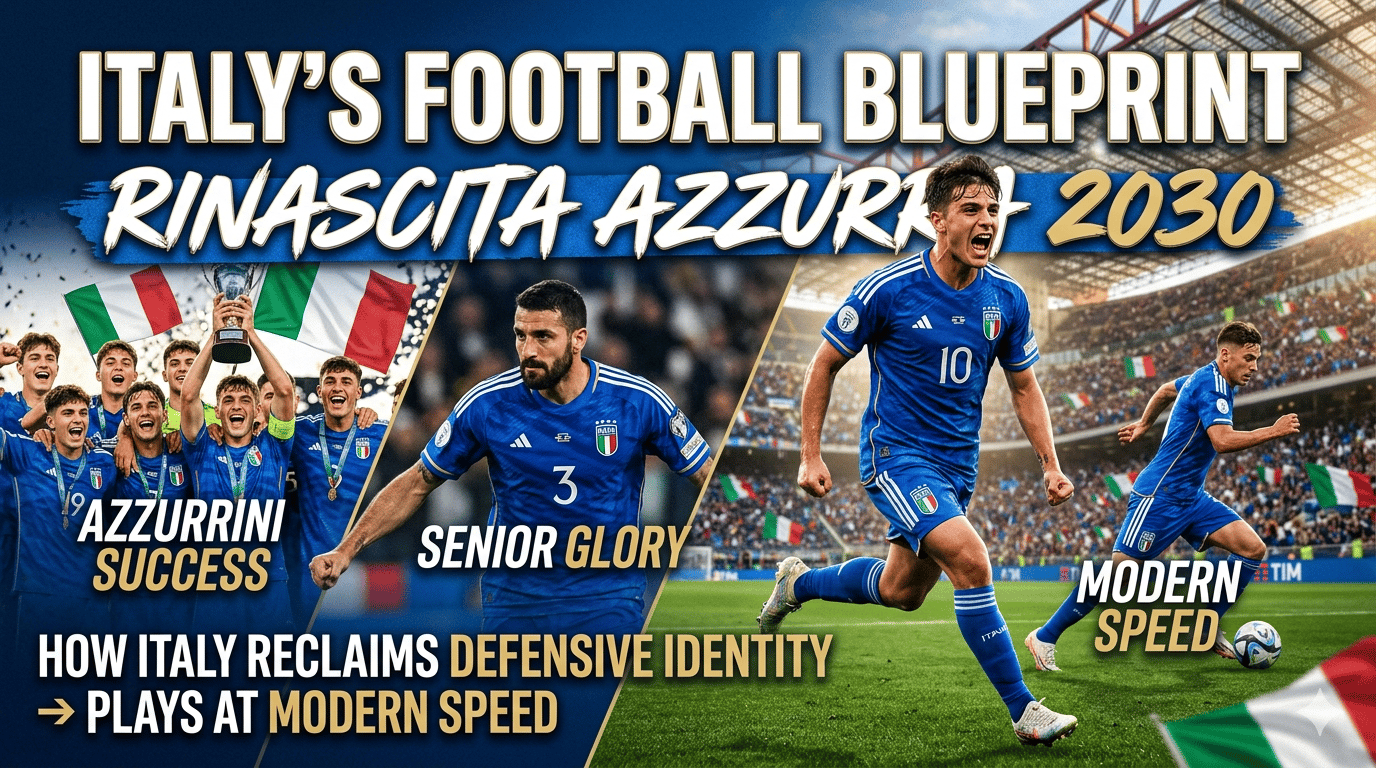
- Italy’s Football Blueprint: Rinascita Azzurra 2030
Italy’s Football Blueprint: Rinascita Azzurra 2030
How Italy Can Transform Its Youth Success into Senior Glory, Reclaim Defensive Identity, and Play at Modern Speed

Blueprint Soccer XI
April 07, 2026
There are failures and then there are signals.
Italy missing three consecutive FIFA World Cups is structural breakdown, one that has been building for over a decade. From the shock playoff loss to Sweden in 2018, to the collapse against North Macedonia in 2022, and now a third consecutive absence, this is no longer an anomaly. It is a pattern.
And yet, the paradox remains.
This is still a nation producing players like Nicolò Barella, Alessandro Bastoni, Gianluigi Donnarumma, and Sandro Tonali core pieces competing at the highest levels in Europe. Inter have reached multiple Champions League finals in recent years with Italian players at the center of their spine. The talent is not only present it is proven.
So why isn’t it translating? Because this is not a talent issue. It’s a system failure.
THE REAL PROBLEM: A DEVELOPMENT MISMATCH
Italy’s development pipeline is not broken at the entry point. In fact, it is one of the most technically refined in Europe.
It consistently produces players who are:
Tactically intelligent
Positionally disciplined
Technically clean under low pressure
These are not minor strengths, they are foundational qualities. But modern football doesn’t reward foundations alone. It rewards execution at speed.
And this is where the cracks appear. At the elite level, Italian players often lack:
Speed of decision-making under pressure
Repeated high-intensity actions (sprinting, pressing, recovery runs)
Adaptability in chaotic, transitional moments
The result is a team that understands the game but cannot keep up with its tempo.
They don’t fail because they think the game incorrectly. They fail because they play it too slowly.
A LOST IDENTITY
There was a time when Italy didn’t need to adapt. They defined the game.
Franco Baresi. Alessandro Nesta. Fabio Cannavaro.
This wasn’t just defensive football, it was defensive dominance. Italy didn’t sit deep. They controlled space, dictated tempo without the ball, and punished mistakes with ruthless efficiency. Their identity was built on defensive intensity, anticipation, and collective intelligence.
Today, that identity feels diluted. Italy is no longer:
The most organized defensive unit
The most aggressive off the ball
The most difficult team to break down
But they also haven’t replaced it with a modern attacking identity. They are caught in between. Not the masters of control they once were. Not the high-speed, transition-driven team the modern game demands.
THE SERIE A BOTTLENECK
At the club level, the problem deepens. Serie A remains one of the most tactically sophisticated leagues in the world—but it is also one of the most risk-averse.
Top clubs:
Rely heavily on experienced international players
Prioritize immediate results over long-term development
Limit opportunities for Italian players aged 19–24
This is the most critical developmental window in football. Across Europe’s top leagues, elite players are:
Starting regularly by 20–21
Playing in European competitions by 22–23
In Italy, many players:
Rotate
Go on loan
Or sit behind veterans
The consequence is delayed development. Players who should peak at 23–26 instead peak at 27–30. At the international level, that delay is fatal.
THE CONTRADICTION (THE MOST IMPORTANT SECTION)
If you only looked at youth tournaments, you would conclude that Italy is entering a golden era.
U19 European Champions (2023)
U20 World Cup Finalists (2023)
U17 European Champions (2024)
This is not a coincidence. It is evidence of a system that still produces elite-level young players.
The Emerging Core:
Francesco Pio Esposito – a modern striker profile combining physical presence with intelligent movement, top scorer at youth level and already knocking on the senior door
Francesco Camarda – widely regarded as a generational attacking talent, defined by instinctive finishing, elite off-ball movement, and confidence beyond his age
Davide Bartesaghi – a dynamic wide player with ability to link phases of play
Michael Kayode – tactically disciplined, strong in duels, and comfortable in structured systems currently playing in the Premier League for Brentford
At U17 level, the profiles shift even further toward modernity:
Attackers comfortable in 1v1 situations
Midfielders capable of receiving under pressure
Players trained in positional flexibility
The pipeline is not just functioning—it is evolving.
So what’s broken?
The bridge between youth success and senior impact.
These players:
Win international tournaments
Demonstrate tactical and technical superiority
Then transition into a system where they:
Play fewer minutes
Operate in slower environments
Lose exposure to high-intensity competition
Instead of accelerating, their development plateaus.
Global Comparison (Where Italy Falls Behind)
Germany (Post-Reboot)
After failures in the early 2000s:
Introduced mandatory academies
Built elite training centers
Standardized development
Result:
Players like Müller, Kroos, Lahm integrated early
World Cup winners within 14 years
France
Clear pipeline from academy → first team
Trust in youth at top clubs
Example:
Mbappé: Ligue 1 starter at 17, World Cup winner at 19
Spain
Clubs like Barcelona integrate youth into elite matches
Players like Pedri and Gavi gain experience early
Italy
Youth success
Elite integration
The delay in exposure creates a developmental gap that compounds over time.
RINASCITA AZZURRA
A Blue Renaissance (2026–2030)
Core Philosophy:
Italy does not lack talent. Italy lacks synchronization between development, opportunity, and identity.
PHASE 1: DIAGNOSE & CENTRALIZE (2026–2027)
“One System, One Language”
Mandatory national curriculum across all academies
Centralized data system tracking:
Minutes played
Physical output
Tactical roles
8–10 FIGC elite development centers
Objective: Create a unified identity
PHASE 2: BRIDGE THE GAP (2027–2028)
“From Talent to Trust”
Financial incentives for clubs developing U23 Italians
“21–23 Acceleration Track” for top prospects
Quarterly club–federation alignment reviews
Objective: Turn potential into opportunity
PHASE 3: DEFINE IDENTITY (2027–2029)
“The New Italian Way”
Italy must evolve from: Slow, structured control
To: Fast, adaptable execution
Less pattern repetition, more real-time decision-making.
THE GAME SPEED MODEL (THE REAL FIX)
Italy must train for a faster game than it plays domestically.
Key shifts:
Constraint-based training (limited touches, time pressure)
High-tempo training blocks (continuous play)
Transition-first mentality
Speed of thought becomes the competitive advantage.
POSITIONAL KPI’S (WHAT SUCCESS LOOKS LIKE)
Defenders:
Progressive carries into midfield
Ability to defend large spaces
Line-breaking passes under pressure
Midfielders:
Decision-making speed
Forward pass percentage under pressure
Press resistance in tight spaces
Attackers:
Forward runs per match (constant vertical threat)
Conversion rate (efficiency relative to chances created)
Possessions won in the final third (pressing effectiveness)
High-speed sprint actions per 90
Touches in the penalty area
THE PATH TO 2030
If implemented correctly:
Players reach peak performance earlier
More Italians gain elite-level experience
The national team regains a clear identity
Not just structured—but fast, aggressive, and adaptable.
FINAL TAKE
Italy’s failure is not rooted in the past. It is rooted in hesitation.
Hesitation to trust youth. Hesitation to evolve tactically. Hesitation to modernize development.
The youth teams have already shown the future. The question is whether the system will allow it to arrive. Because in modern football, time is everything. And Italy has already lost too much of it. Rinascita Azzurra isn’t a rebuild. It’s a race against time.