- Blueprint Soccer XI
- Posts
- Blueprint to Performance: Newcastle’s Reality Check & The USMNT’s World Cup Test
Blueprint to Performance: Newcastle’s Reality Check & The USMNT’s World Cup Test
From reflection to preparation—using Newcastle’s March as a case study to define the structural, tactical, and statistical demands facing the USMNT this summer.

Blueprint Soccer XI
March 24, 2026
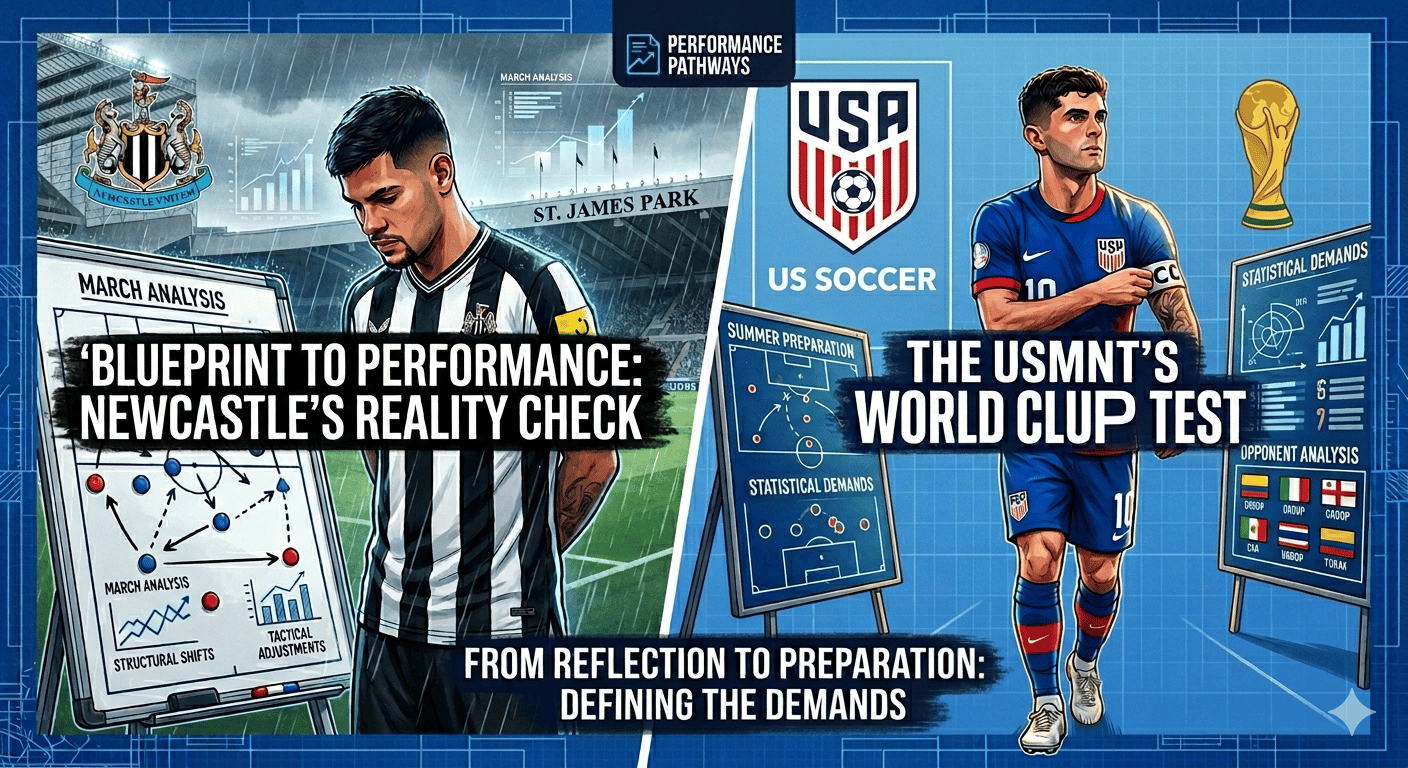
This two-part newsletter connects reflection and preparation—looking back at Newcastle’s recent stretch while examining how those same challenges are about to face the U.S. Men’s National Team.
At the beginning of the month, we broke down Newcastle United F.C.’s run of fixtures through March, arguably the most demanding stretch any team in Europe faced this season based on opposition form.
Now, it’s worth revisiting how they actually performed and more importantly, where the data shows they came up short.
If you missed the original piece, you can find it here:
https://blueprintsoccerxi.beehiiv.com/p/newcastle-united-s-season-defining-march-an-educational-blueprint-for-coaches
We then shift forward to the USMNT’s upcoming tests against the Belgium national football team and Portugal national football team, using these matches to define the key areas of focus ahead of World Cup preparation.
NEWCASTLE UNITED — MARCH 2026 BLUEPRINT REPORT
A data-led look at performance, structural limits, and what comes next
OVERVIEW — OUTPUT VS. RESULTS
Record: 2W – 2D – 2L
Goals: 8 For / 14 Against
xG (For): 1.52 avg
Shots on Target: 4.5 per game
Possession: 43% avg (sub-50% in 5/6)
Immediate Takeaway: The outputs suggest a mid-table side. The results and how they arrived, suggest a team with a narrow operating range.
PERFORMANCE BAND ANALYSIS
Across five of six matches, Newcastle operated within a tight attacking band:
xG Range: 1.10 – 1.54
SOT Range: 4–5 per game
Goal Output: 6 goals across those 5 matches
Translation:
Chance creation = consistent
Chance quality = moderate
Goal return = underperformance
This is not volatility. This is a ceiling.
A team producing ~1.4 xG should average closer to 1.5–1.8 goals per match. Newcastle averaged 1.0.
Blueprint Insight:
When output remains stable but goals do not scale, the issue is not system design, it is final action efficiency.
FINISHING DEFICIT (PRIMARY LIMITER)
Key Indicator:
4.5 shots on target → ~1 goal per game
At this level, that conversion rate is below top-four standard.
Elite sides convert 30–35%+ of shots on target
Newcastle’s March conversion sits closer to 20–22%
Impact Across the Month:
4 matches decided by 1 goal
xG margin sufficient to produce 2+ goals in multiple fixtures
Outcomes flipped by lack of clinical finishing
Compounding Factor — Absence of Bruno Guimarães
Without him:
Fewer progressive carries
Reduced vertical passing into final third
Slower transition from regain → chance creation
System Effect:
Midfield shifted from progression unit → containment unit
That shift lowers chance quality without significantly reducing volume — which is exactly what the data shows.
POSSESSION PROFILE & TACTICAL DEPENDENCY
Average Possession: 43%
Possession Wins (Results): vs direct opponents
Possession Loss (Result): vs Sunderland (60% possession, loss)
Interpretation: This is not a possession issue. This is a possession dependency issue.
Newcastle’s Two Game States:
A. Without Ball (Preferred State)
Compact block
Transition-based attacks
Effective vs direct teams
B. With Ball (Forced State)
Increased possession (>55%)
Reduced attacking clarity
Struggles vs low blocks
Evidence Point — Sunderland Match
60% possession
1.27 xG
1 goal
Loss
Blueprint Insight: Newcastle do not just prefer to play without the ball, they currently require it to function optimally.
STRUCTURAL STRESS TEST (ELITE OPPOSITION)
vs Positional-Dominant Teams:
Manchester City
FC Barcelona
Observed Pattern:
Defensive block holds initially
Passing volume disparity increases over time
Structural fatigue → breakdown
Critical Data Point: Heavy defeats correlated with sustained opposition possession (400+ passes)
BARCELONA SECOND LEG — KEY MOMENT ANALYSIS
Game State: 2–2
At this point:
Newcastle still structurally intact
System functioning within design
Post-2–2 Collapse:
5 goals conceded
Defensive distances increased
Press coordination lost
Game state became transitional chaos
xG Context:
Newcastle: 1.54
Conceded: 7 goals
Interpretation:
This was not an open exchange. This was loss of control without a recovery mechanism.
Blueprint Insight: The system lacks a stabilization phase when game state breaks.
IDENTITY DEFINITION
Current Newcastle Profile:
Well-coached
Structurally disciplined
Transition-focused
Competitive vs top sides in controlled conditions
But…
Two Structural Gaps Define the Ceiling:
1. FINISHING PROFILE (PERSONNEL GAP)
Requirement:
Forward capable of converting 0.3–0.5 xG chances consistently
Why it matters:
Converts 1-goal outputs → 2-goal outputs
Changes match outcomes without altering system
March Impact: Minimum 3–4 matches where 1 additional goal changes result
2. SECOND TACTICAL LANGUAGE (SYSTEM GAP)
Current State:
One dominant identity: defend + transition
Missing Layer:
Controlled possession structure:
Positional spacing
Low-block manipulation
Central overload creation
Evidence:
Sunderland loss
Struggles when forced above 55% possession
RESULT VARIANCE IS STRUCTURAL, NOT RANDOM
Pattern:
Win vs Manchester United
Compete vs Barcelona
Lose to Sunderland
This is not inconsistency in effort or mentality. This is context dependency.
Newcastle’s performance level is currently tied to:
Opponent style
Game state
Ability to play in transition
Remove those conditions → performance drops.
BLUEPRINT FOR PROGRESSION
This is not a rebuild phase. This is an expansion phase.
PRIORITY 1 — STRIKER PROFILE
High conversion rate inside the box
Minimal reliance on volume
Efficient finisher vs elite goalkeepers
PRIORITY 2 — MIDFIELD CONTROL (WITH OR WITHOUT GUIMARÃES)
Additional ball progression option
Press resistance
Tempo control in possession phases
PRIORITY 3 — POSSESSION STRUCTURE
Defined attacking patterns vs low block
Positional rotations in final third
Ability to sustain pressure, not just absorb it
FINAL VERDICT — A TEAM AT ITS EDGE
March wasn’t failure. It was exposure and a missed opportunity to gain momentum heading into the final stretch of the season.
Newcastle showed:
They can compete with elite teams
They can execute a clear tactical identity
But they also showed:
That identity has limits
And those limits are predictable
The gap to the top isn’t massive. But it is specific.
Add efficiency in front of goal. Add control when forced to dominate.
And this becomes a consistent Champions League team, not one that depends on the type of game being played.
PART 2: 🇺🇸 USMNT World Cup Preparation
What Matches Against Belgium and Portugal Will Actually Reveal
As the FIFA World Cup approaches, games against the Belgium national football team and Portugal national football team aren’t just preparation—they’re measurement.
Not of talent. Not of effort. Of readiness at the highest level.
Because these are not random opponents. These are the profiles you face in knockout football: technically secure, tactically disciplined, and efficient in both boxes.
So instead of focusing on results, this becomes an exercise:
What must the U.S. prove—structurally and statistically—to show they can compete when margins get tight?
Possession Reality & Game State Profile
Let’s start with what the data likely tells us before a ball is even kicked.
Projected Match Profile:
Possession: 35–45%
Opponent Pass Volume: 400–600 passes
USMNT Pass Volume: 250–400 passes
Time Defending in Block: 55–65% of match
This isn’t speculation—it’s consistent with how top European sides control games against athletic, transition-based teams. Look at stats from Fotmob (not a sponsor, but maybe one day!) to see how Belgium and Portugal performed against recent opposition.
The implication is clear:
The U.S. will spend more time without the ball than with it.
So the evaluation shifts from:
“How well do we play?” to “How well do we function without control?”
That is knockout football.
Defensive Structure: The Non-Negotiable Metric
If possession drops below 40%, defensive structure becomes your primary performance indicator.
Key Benchmarks:
Compactness (line spacing): < 15–25 yards vertically
Shots conceded: ≤ 10–12
High-quality chances conceded (xG): ≤ 1.5
Box entries allowed: Controlled, not repetitive - forced wide
The focus isn’t eliminating chances—it’s controlling chance quality.
Against teams like Belgium and Portugal:
You will concede shots
You will defend deep
You will face sustained pressure
The difference between competing and collapsing is simple:
Do you force low-quality outcomes, or do you lose structure and focus?
Because once distances stretch—especially between midfield and back line, centrally, the game unravels beyond your control.
Transition Efficiency: Output Over Volume
If the U.S. averages 40% possession, then transition isn’t a phase—it’s the primary attacking model.
Expected Transition Profile:
Total transitions: 8–12 per match
Meaningful attacking transitions: 3–5
Target xG from transitions: 0.8–1.2
You’re not building attacks through volume, you’re relying on efficiency in limited moments.
So the real metrics become:
First forward pass success rate
Time from regain to final third entry (≤ 8–10 seconds)
Number of runners supporting the ball (minimum 2–3)
The takeaway:
At this level, one wasted transition isn’t a moment—it’s a missed opportunity you may not get back. Think about the 2010 FIFA World Cup moment when Landon Donovan scored against Algeria late!
Chance Creation Without Control
Here’s where most teams at this level get exposed.
They equate attacking output with possession volume.
But in tournament football, especially against elite sides, chance creation comes from specific moments, not sustained dominance.
Target Creation Model:
Set piece xG contribution: 0.3–0.5
Transition xG contribution: 0.6–1.0
Total xG target: ~1.2–1.8
How do those chances actually show up?
Set pieces (corners, wide free kicks)
Transitional overloads (3v3, 4v4 moments)
Isolation of wide players in space
If those channels don’t produce, the attack stalls.
You don’t need 15 chances. You need 3–4 that actually matter.
Game Management: Controlling the Uncontrollable
This is where data meets behavior.
Because momentum in these games is inevitable, you will have phases where you’re under pressure, and brief moments where you’re on top.
Under Pressure Metrics:
Fouls won in defensive third and central midfield
Clearances with retention (vs giveaways)
Time to reset defensive shape (< 6–8 seconds)
When Momentum Shifts:
Pass completion under pressure (> 80% in short phases)
Ability to sustain possession for 20–30 seconds
Shot selection (no forced low-percentage attempts)
This isn’t about style—it’s about control within chaos.
The best teams don’t eliminate pressure. They manage it.
Controlled Urgency: Game State Intelligence
Game state dictates behavior, and behavior determines outcomes.
When Leading:
Defensive line drops slightly, not excessively
Possession becomes purposeful, not passive
Tempo slows without losing structure
When Trailing:
Lines compress higher up the field
Tempo increases—but within structure
Risk increases—but remains coordinated
The key metric here isn’t physical—it’s cognitive:
Does the team maintain structure as urgency increases?
Because most teams don’t lose games from lack of effort—they lose them from losing control.
Why Belgium and Portugal Are the Benchmark
These aren’t just high-level teams—they’re reference models.
They combine:
Technical security
Tactical discipline
Efficiency in both boxes
Typical Output vs Teams Like the U.S.:
Possession: 55–65%
xG generated: 1.5–2.5
Chances needed per goal: Low
They don’t need volume. They need moments. Which is exactly what knockout football demands.
Analyst’s Framework
These matches aren’t about whether the U.S. wins or loses. They’re about whether the following thresholds are met:
Defensive xG conceded ≤ 1.5
Transition xG generated ≥ 0.8
Total xG ≥ 1.2
Structural discipline maintained across all game states
If those numbers are consistent, the team is competitive. If they’re not, the gaps aren’t tactical, they’re structural.
Final Thought
At this level, performance isn’t about how good you look—it’s about how repeatable you are under pressure.
Can you:
Defend with discipline for 60+ minutes?
Maximize limited attacking moments?
Manage momentum without losing structure?
Because if those answers start to trend in the right direction in these matches, then this isn’t just preparation.
It’s proof of a team that understands what it takes to win when control is no longer guaranteed.