- Blueprint Soccer XI
- Posts
- Blueprint: Ownership Is the Separator in Modern Player Development
Blueprint: Ownership Is the Separator in Modern Player Development
If players have more access than ever, why aren’t they improving? The answer comes down to one missing piece: ownership.

Blueprint Soccer XI
April 21, 2026
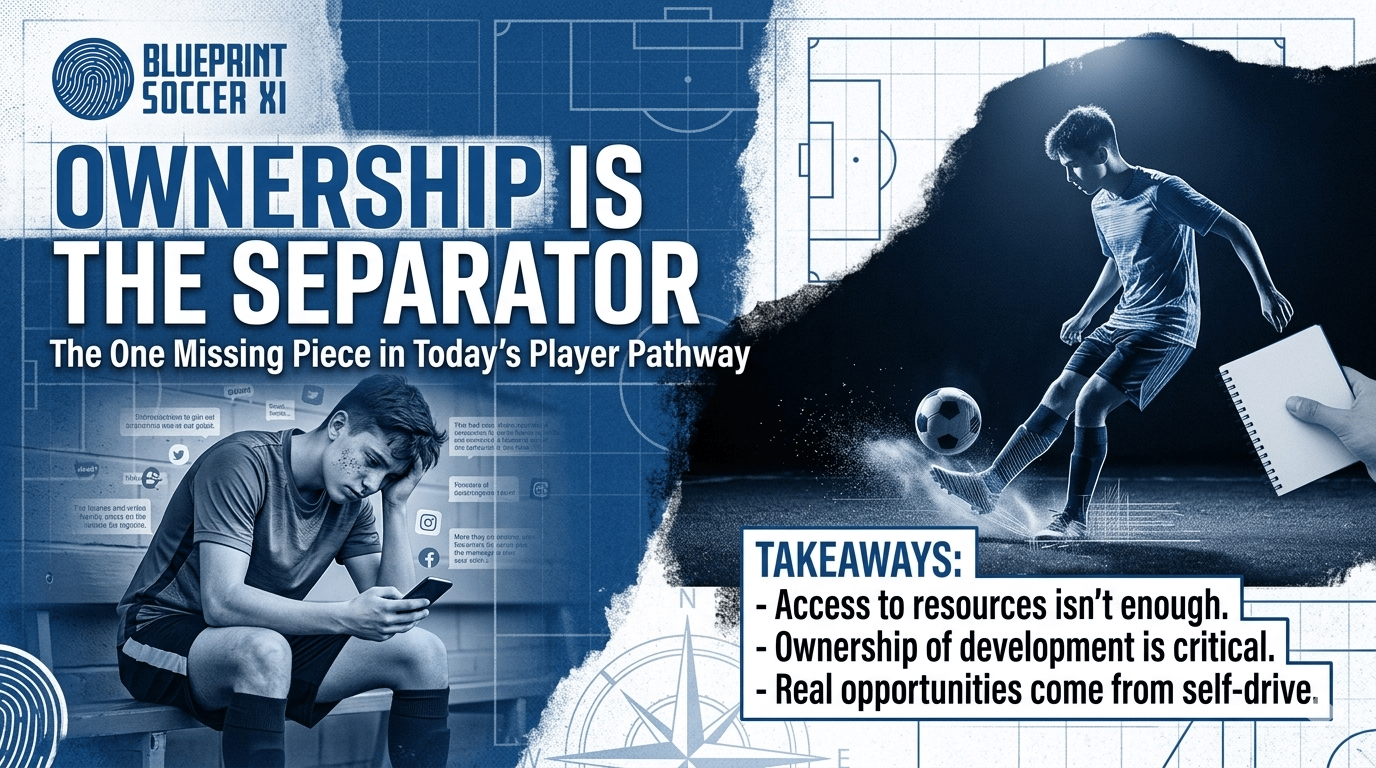
If you strip away all the distractions in today’s player pathway—showcases, player rankings, social media clips, constant games you’re left with something simple: most players go through the motions and lose sight of what actually matters long term, while those who take ownership of their development separate themselves and create real long-term opportunities.
I’ve seen this from both sides, first as a player trying to figure it out, now as a coach watching patterns repeat over and over again. And that’s the key word: patterns. Not one-off moments or highlight clips, but what shows up consistently over time.
Right now, the pattern is clear. Players have more access than ever before, more games, more tools, more information. But the level of accountability hasn’t kept up.
Players are constantly training, playing, and posting but they’re repeating the same habits, making the same mistakes, and not actually improving key parts of their game like decision-making, positioning, or awareness.
This isn’t about talent. And it’s not really about coaching either.
It comes down to ownership.
This newsletter isn’t meant to overwhelm you. It’s meant to give you a simple structure you can start using right away to take control of your development.
1. You Are the Project
A lot of players treat development like something that happens to them:
“Coach will fix it”
“Training will take care of it”
“Games will make me better”
That mindset keeps you dependent.
The players who actually move forward think differently:
Training is a tool
Games are feedback
Coaches are resources
But the responsibility? That sits with you.
Be honest with yourself:
Do I know why I play well when I’m playing well?
Do I know why I struggle when things aren’t going right?
If you don’t have clear answers, that’s your starting point—not your coach’s.
2. The Game Is the Test. Film Is the Teacher.
Most players either don’t watch film—or they watch it the wrong way.
They:
Watch highlights
Focus on big moments
Skip over mistakes
That won’t move you forward.
A Simple Film Review Process (Start Here)
After each game, go back and review 3–5 clips max. That’s it.
Focus on moments where:
You’re receiving the ball
You’re making a decision
You’re off the ball (positioning)
You’re reacting in transition
Step 1: Observe (No opinions yet)
Write down:
What did I see?
What did I do?
What happened next?
Keep it factual.
“I received with my back to pressure, took two touches, and played backward. The press closed and we lost space.”
No:
“That was bad”
“I need to be better”
Just facts. This builds awareness without emotion.
Step 2: Identify ONE reason
Pick the main cause:
Late scanning
Poor body shape
Didn’t recognize pressure
Rushed decision
Technical execution
Not three things. Not everything. One.
That’s how you start getting clear.
Step 3: Decide the solution
Now ask:
“If this happens again, what will I do differently?”
Example:
“I’ll scan earlier and open my body so I can play forward first touch.”
Now you’re preparing for the next game—not just replaying the last one.
Step 4: Apply it in training
If what you saw on film doesn’t show up in training within the next couple of days, it didn’t stick.
At that point, you’re just watching, not learning.
3. Ask Better Questions, Get Better Answers
One of the biggest giveaways of a player who isn’t fully engaged is this question:
“Coach, what do I need to improve?”
It sounds fine, but it shows you haven’t done the thinking yet.
You’ll get much better feedback when you bring something specific.
Instead of:
“How do I get better?”
Try:
“I’m struggling to receive under pressure facing forward, am I scanning too late or is my body shape off?”
“When the 6 is marked in build-up, where should I position myself to find space?”
Now the coach can actually work with you.
Simple Rule
After every game or session, you should have:
1 clear observation
1 specific question
If you don’t, you probably didn’t reflect enough.
4. Mental Preparation: Stop Just Showing Up
Most players show up and hope it goes well. That’s not preparation. That’s reaction.
You don’t need anything complicated, just a simple routine.
Before Training (5 minutes)
Ask yourself:
What’s my focus today? (based on film)
Where will I see this in training?
Example: “Today I’m focusing on scanning earlier before I receive.”
That’s enough. One focus.
Before Games (10 minutes)
Break it into three parts:
1. Role clarity
What’s my job in this team?
What situations will I be in most?
2. Key actions
What do I need to do well today?
Example:
Receive under pressure
Play forward quickly
Stay connected defensively
3. Response plan
What will I do when things don’t go well?
Because they won’t always go well. This is what keeps you composed.
5. Reflection: Where You Actually Improve
Within 24 hours of a game, sit down and ask:
What did I do well? (be specific)
Where did I struggle? (look for patterns)
Why did it happen?
Most players stop at:
“I played bad”
“I wasn’t on it today”
That doesn’t help you.
Be precise: “I struggled receiving under pressure because I wasn’t scanning early enough.”
Now you have something you can fix.
6. Train With Intent, Not Just Effort
Working hard is expected, that's the baseline. What separates players is training with purpose.
Before training:
Know your focus (from film)
During training:
Look for those moments over and over
After training:
Did I execute it?
What actually improved?
If you train without intent, you’ll feel like you worked, but your development will move slower than it should.
7. Build a Weekly Routine That Keeps You Accountable
Keep it simple and repeatable.
Game Day
Compete
Take mental notes
Next 24–48 Hours
Review 3–5 clips
Go through observation, diagnosis, solution
Training Days
Apply one focus
Reflect briefly after
End of Week
What got better?
What still needs work?
Consistency beats complexity every time.
8. Be Honest About This
You won’t improve if you:
Avoid your weaknesses
Ignore honest feedback
Only focus on what you’re already good at
You also won’t improve just by:
Playing more games
Joining more teams
Chasing exposure
Those things only matter once your level is actually improving.
9. What Coaches Actually Notice
It’s not just talent.
It’s:
Awareness
Ability to adjust
Decision-making
Accountability
When a player comes up and says: “I’ve been struggling in this situation and I’ve been trying to fix it this way—what do you think?”
That stands out right away. It shows that the player is thinking and invested which leads to faster improvement.
10. Ownership Is a Choice
No one can force this on you.
Your coach can:
Guide you
Challenge you
Support you
But they can’t:
Think for you
Reflect for you
Improve for you
That part is yours.
Start Here This Week
Keep it simple:
Review one game (3–5 clips)
Write down 1 observation and 1 question
Bring that question to your coach
Apply one focus in training
That’s it. Do that consistently, and you’ll already be ahead of most players.
The gap right now isn’t access or opportunity. It’s ownership.
And once you actually take that seriously, everything starts to change.